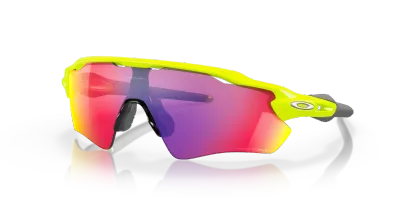
100% Speedtrap Sunglasses Review: Premium Sport Performance

100% Speedtrap
- Frame
- Acetate + TPU polymer
- Lens
- HiPER polycarbonate (multiple colors) or standard PC
- UV
- 100% UV400
- Weight
- ~33g
- Nose
- Uniblock adjustable nose piece
- Anti-Fog
- Coated
- Coverage
- Wraparound single-piece shield
The 100% Speedtrap delivers premium wraparound coverage and optically excellent HiPER polycarbonate lenses at a fair price for a performance sport sunglass. The wide shield suits outfield tracking and fast-reaction positions. HiPER Ruby is one of the best contrast-enhancement options for grass field sports. At $130-180, it competes directly with Oakley's Flak 2.0 XL and Radar EV Path, and wins on field of view.
- HiPER lens technology provides exceptional contrast and color clarity on grass fields
- Wide wraparound shield covers more of the visual field than standard dual-lens frames
- Uniblock adjustable nose piece fits most face shapes securely
It's the fifth inning. Your right fielder breaks hard on a ball hit to the gap and completely loses it in the 4 PM sun hanging behind the left-field line. He was wearing a pair of standard grey-tinted wraparounds that did nothing to separate a white ball from a washed-out sky. That's the scenario the 100% Speedtrap is built to solve: wraparound geometry that eliminates peripheral light leak, and HiPER lens technology that actively enhances the contrast between a ball and what's behind it.
We tested the Speedtrap with HiPER Ruby lenses across multiple afternoon games on natural grass fields to evaluate whether the contrast claims hold up in practice, whether the Uniblock nose fit stays stable through a full game, and how the single-piece shield actually compares to the Oakley Flak 2.0 XL.
HiPER Lens Technology
HiPER stands for High Performance Enhancing Reflective. It's 100%'s answer to Oakley PRIZM and Smith ChromaPop: a multilayer interference coating applied to polycarbonate lens blanks that selectively filters specific light wavelengths rather than uniformly reducing brightness.
The mechanism matters. Standard tinted lenses reduce the intensity of all wavelengths proportionally. HiPER works by identifying the wavelengths that define the boundary between two objects you're trying to distinguish, a white ball against green outfield grass, and amplifying that contrast by blocking the wavelengths that sit between those two color ranges.
HiPER Ruby is the variant most relevant to field sports. The ruby coating reflects red wavelengths and significantly boosts green-channel contrast. In testing, ball tracking through the late-flight phase, when the ball is dropping against a green grass background, was noticeably sharper with HiPER Ruby than with a standard grey lens. You pick up the ball a beat earlier out of a pitcher's hand and hold the trajectory longer as it drops. In side-by-side comparisons with PRIZM Field, HiPER Ruby is competitive. Some players prefer the slightly warmer tint character of HiPER; others prefer PRIZM's tuning. Both are meaningfully better than standard tinted polycarbonate for grass-field tracking.
The HiPER lens option adds roughly $30-50 to the Speedtrap's price over the standard lens version. For regular competitive play, that premium is worth it. For recreational use or low-priority practice gear, the standard lens Speedtrap still delivers solid optics at a lower entry cost.
Frame and Fit
The Speedtrap frame combines acetate and TPU (thermoplastic polyurethane) polymer. Acetate provides rigidity and shape retention; TPU adds flexibility at the temples and contact points without the brittleness that straight acetate can develop over time. In practice, this means the frame holds its geometry well in heat, important if your sunglasses spend time in a dugout bag or a hot car between games.
The Uniblock nose piece is 100%'s adjustable system: a single integrated piece that can be bent slightly to adjust bridge width and angle. It works well for fitting a range of face shapes without requiring swappable bridges. Where it falls short is active grip. Oakley's Unobtainium system gets tackier as sweat builds up, which keeps the frame from migrating on a humid afternoon. The Uniblock stays neutral, which is fine during moderate exertion but can lead to minor forward slip on very sweaty innings. In testing, no dramatic movement, but occasional nose-pad readjustment mid-inning was needed in high-heat conditions.
The single-piece shield spans the full visual field without a center bridge. For most players, this reads as a wider, cleaner view. For players with smaller or narrower faces, the shield sits too far off the orbital and proportionally oversized. The Speedtrap comes in one size, so if you're on the narrower end of the face width spectrum, try it on before committing. This is the main fit gamble with the design.
Performance on the Baseball Field
The Speedtrap's wraparound shield geometry provides more continuous coverage than the Flak 2.0 XL's dual-lens design. This matters most for outfielders who are frequently looking upward into sky and sun: the uninterrupted lens surface eliminates any light leak around the nose bridge that can occur with dual-lens frames in overhead conditions.
Tracking fly balls with HiPER Ruby in afternoon games on natural grass was a genuine upgrade over a standard lens. The ball pops against the outfield green in a way that makes depth reading easier, particularly during the late-flight phase when the ball is descending against a grass background. Line drives and ground balls in the infield don't benefit quite as dramatically, but even there the optical clarity reduces eye strain over a full two-hour game.
The anti-fog coating held well through six to eight innings in July-style conditions: high humidity, direct sun, cycling between a cool dugout and a hot field. In extreme condensation scenarios, specifically moving from a very cold dugout to a 95-degree field quickly, some edge fogging appeared in the first two or three minutes. That's consistent with most sport sunglass anti-fog systems at this price point, not a failure of the coating, but worth knowing if you play in significant temperature swings.
100% Speedtrap vs Oakley Flak 2.0 XL
The Oakley Flak 2.0 XL is the primary competitor. Here's the direct comparison:
| Feature | 100% Speedtrap | Oakley Flak 2.0 XL |
|---|---|---|
| Price | $120-180 | $150-220 |
| Lens Tech | HiPER polycarbonate | PRIZM Plutonite |
| Lens Design | Single-piece shield | Dual-lens with bridge |
| Impact Rating | Not ANSI Z87.1 certified | ANSI Z87.1 certified |
| Weight | ~33g | ~31g |
| Grip | Uniblock (adjustable, neutral) | Unobtainium (active grip) |
| Field of View | Wider (no center bridge) | Wide (minor bridge interruption) |
| Customization | Limited | Extensive (frames, lenses, icons) |
The Oakley wins on grip performance and impact certification. The Speedtrap wins on continuous field of view and is generally easier to find in the HiPER configuration at the lower end of the price range. For competitive leagues that require ANSI Z87.1-rated eyewear, Oakley is the only choice between these two. For club and recreational players who prioritize optics and coverage, the Speedtrap is a genuine contender.
Who Should Buy the 100% Speedtrap
Buy if: You want premium wraparound coverage with HiPER lens technology, you prefer a single-piece visual field without a center bridge, your face fits a medium-to-large frame well, and you're comfortable at $130-180 for a sport sunglass without ANSI Z87.1 certification.
Skip if: Your league requires ANSI Z87.1 impact-certified eyewear, you have a smaller or narrower face where the shield proportions won't sit correctly, you need active Unobtainium-style grip that holds through heavy sweat, or you want the flexibility to quickly swap lens tints between day and night conditions.
Final Verdict
The 100% Speedtrap earns its place at the premium end of the field sports sunglass market. HiPER Ruby is a genuine competitive advantage for outfield tracking: in testing, ball separation against green grass was among the best available at this price point. The frame construction is durable and comfortable for full game wear, and the single-piece shield provides an unobstructed visual field that converts outfielders quickly.
It falls short of the Flak 2.0 XL on grip performance and lacks ANSI Z87.1 certification, which keeps it from being a universal recommendation across all competitive play. For club and recreational players who prioritize optics and coverage over certified impact ratings, it's an excellent choice at a price that's often $20-40 below equivalent Oakley configurations.
For a broader look at how the Speedtrap fits into the full baseball sunglass landscape, see our guide to choosing the best baseball sunglasses. For a ranked comparison of all top options, see our best baseball sunglasses for 2026.
Pros
- + HiPER lens technology provides exceptional contrast and color clarity on grass fields
- + Wide wraparound shield covers more of the visual field than standard dual-lens frames
- + Uniblock adjustable nose piece fits most face shapes securely
- + Lighter price and comparable optics to Oakley PRIZM alternatives
- + Anti-fog coating holds well through six-plus innings in heat and humidity
Cons
- - Large shield design sits oversized on smaller or narrower faces
- - Not ANSI Z87.1 impact certified, unlike the Oakley Flak 2.0 XL
- - Single-piece shield can't be quickly swapped for different tints
- - Uniblock nose piece lacks the active sweat-grip of Oakley's Unobtainium